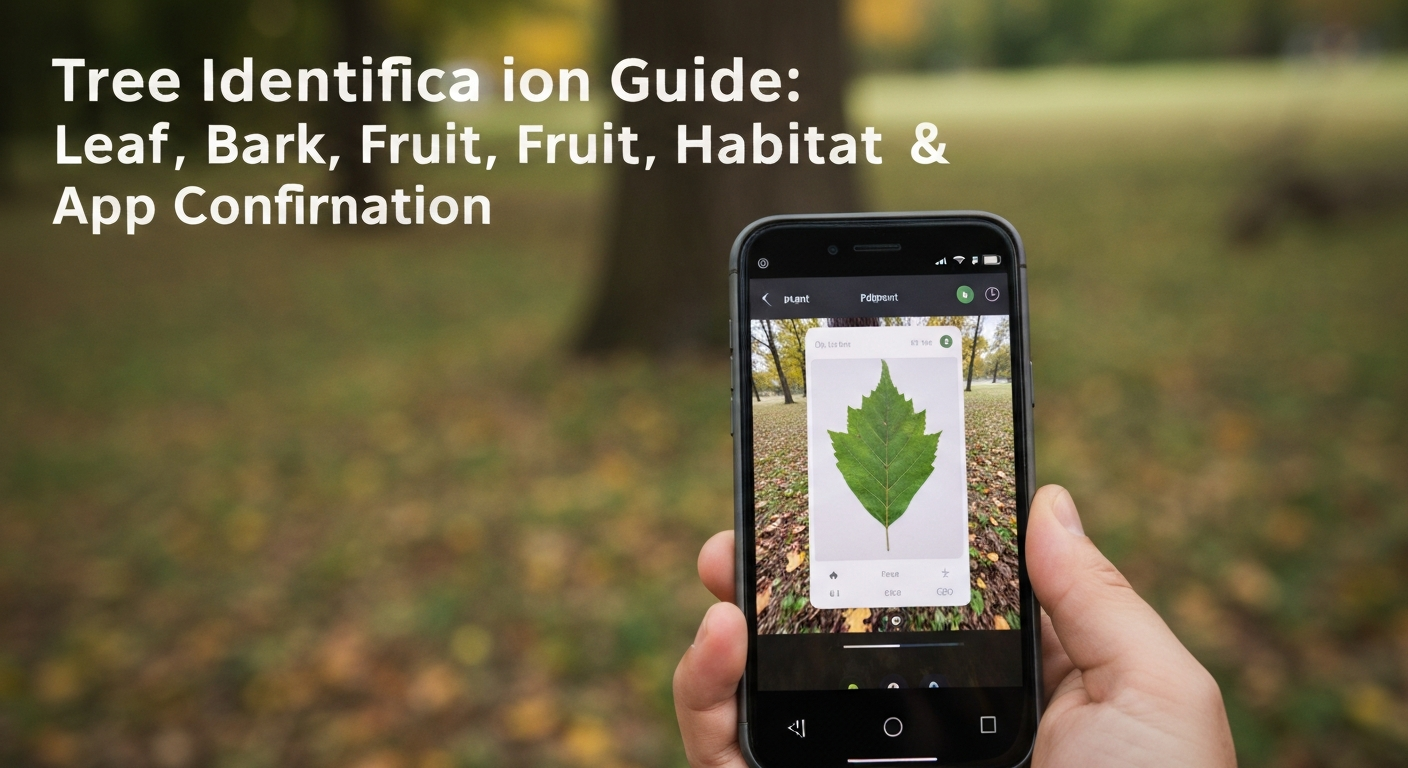
TL;DR: This tree identification guide teaches a five-step field method any beginner can use: (1) read the leaf — arrangement, simple vs compound, margin; (2) check bark at chest height; (3) note fruit, nuts, flowers, or cones; (4) match habitat and region; (5) confirm with the Tree Identifier app and a second photo. Do not skip confirmation. Leaf shape alone is a hypothesis; bark plus fruit plus location turns that hypothesis into a name you can trust on a yard tree or trail find.
🌲 Memorize the sequence: leaf → bark → fruit → habitat → app. That order is the backbone of every reliable tree identification guide — and the fastest path from “what is this?” to a confident species name.
Why you need a method, not a lucky guess
North America has hundreds of tree species in yards, parks, and forests. Beginners who jump straight to “it looks like an oak” often land on the wrong genus — and wrong care advice, wrong allergies, wrong forage decisions. A structured tree identification guide prevents that.
Trees share traits across families. Lobed leaves appear on oak, maple, sycamore, and sweetgum. Compound leaves appear on ash, hickory, walnut, and locust. Shaggy bark appears on shagbark hickory and some maples. The point of a method is to stack independent clues until only one or two candidates remain.
This page is the hub: use it to learn the system, then dive into specialized posts for foliage detail, bark patterns, photo technique, and common backyard species. When you need tables instead of narrative, pair this guide with a tree identification chart or a decision-style tree id chart.
Step 1: Identify trees by leaf
Leaves are the default starting point from late spring through early autumn. Work four leaf questions in order — the same order used in our dedicated identify trees by leaf photo guide.
1. Arrangement on the twig. Are leaves opposite (two at each node — maple, ash, dogwood, buckeye) or alternate (one per node — oak, birch, elm, cherry, hickory)? Opposite arrangement is uncommon enough that finding it immediately shrinks the candidate list. Whorled leaves (three or more at a node) are rare — think catalpa.
2. Simple vs compound. One blade per petiole = simple (oak, maple, beech). Multiple leaflets on one stalk = compound (walnut, hickory, ash, locust). Follow the stalk to the twig: if several blades share one attachment, count them as one compound leaf.
3. Margin and lobes. Smooth (entire), toothed (serrate), or lobed? Oak and maple both lobed — but oak is alternate and maple is opposite. Sweetgum has five pointed star lobes; sycamore has broader maple-like lobes with different bark.
4. Venation and size. Palmate veins radiate from one point (maple). Pinnate veins branch from a midrib (oak, birch). Giant heart-shaped leaves suggest catalpa or catalpa-like ornamentals; tiny compound leaflets suggest honey locust.
For deeper foliage language — petiole, rachis, sinus, leaflet — keep the tree anatomy glossary open. For seasonality and foliage tricks, see how to identify tree foliage.
Practice species: walk a red maple (opposite, simple, lobed), a white oak (alternate, simple, rounded lobes), and a black walnut (alternate, pinnately compound). Those three cover most beginner confusion in one afternoon.
Step 2: Confirm with bark
Bark is your year-round safety net and your check on leaf hypotheses. Photograph the trunk at chest height — not the base where soil splash and moss distort color, and not only the twig bark of young stems.
Useful bark categories for this tree identification guide:
- Smooth gray: American beech, young maple, some cherries — look for raised scars or horizontal lenticels.
- Platy or exfoliating: River birch peels in papery curls; sycamore sheds large mottled plates revealing white underbark.
- Furrowed and ridged: Many oaks, ashes, and mature maples — note ridge width, depth, and color in the furrows.
- Shaggy plates: Classic shagbark hickory — long peeling strips that curl at the ends.
- Blocky or alligator: Persimmon, black gum, and some mature oaks.
Bark alone rarely delivers species, but bark plus leaf arrangement often does. Full patterns and photo tips live in the identify trees by bark guide.
Step 3: Use fruit, flowers, nuts, and cones
Reproductive structures are the strongest species-level clues. When present, weight them heavily.
- Acorns: Oak genus. Cap shape and nut size separate white oaks from red oaks with practice.
- Helicopter samaras: Maple (paired) or ash (single winged seeds).
- Nuts in husks: Hickory and walnut — husk thickness and leaflet count finish the ID.
- Cones: Pines, spruces, firs — needle arrangement and cone orientation matter.
- Pods: Locust, redbud, catalpa — length and shape differ dramatically.
- Berry-like fruits: Mulberry, dogwood, serviceberry — check leaf and bark before foraging.
Fall and winter are excellent for persistent fruit. Empty catalpa pods hanging like beans, maple samaras clinging into December, and ash seeds in clusters all identify trees after leaves drop.
Step 4: Match habitat, region, and context
Ask: Where am I standing, and what trees are typical here?
Wet vs dry. Willows, cottonwoods, river birch, and bald cypress favor water. Blackjack oak, eastern redcedar, and pine often hold dry ridges. Planting in a lawn ignores native ecology — note whether the tree looks intentionally planted.
Region. Live oak ID makes sense in the Southeast Gulf Coast; it does not make sense as a spontaneous wild tree in northern Minnesota. Apps use location metadata when available; you should too.
Urban vs wild. Street trees include Norway maple, Callery pear, Bradford cultivars, ginkgo, and ornamental cherries. Forest edges favor natives and a few aggressive invasives like tree-of-heaven.
Browse the short list in common backyard trees in the US before chasing rare species. Most “mystery trees” on suburban lots are already on that list.
Step 5: App confirmation — and how to use it well
Phone apps close the gap between a short candidate list and a species name. The Tree Identifier app is built for leaf, bark, and fruit photos of North American trees. Use it as step five of this tree identification guide — not as a replacement for steps one through four.
Workflow:
- Capture a sharp leaf photo (full blade, margin visible).
- Capture a bark patch and, if available, fruit or flower.
- Submit the best shot first; if results are ambiguous, submit a second trait.
- Read the top match and alternates. Check that each grows in your state or metro area.
- Sanity-check opposite/alternate and fruit type against the app suggestion.
Photo quality drives accuracy. Side-lit leaves, glare, extreme close-ups of damaged tissue, and distant canopy shots all weaken results. Follow best photo for tree ID before blaming the model. When choosing among apps, compare features in app to identify trees.
Worked example: backyard red maple vs nearby oak
You find a lobed green leaf under a mid-sized lawn tree.
Leaf: Three to five lobes with pointed tips and V-shaped sinuses. Opposite on the twig. Not oak (oaks are alternate).
Bark: Gray with shallow furrows on a mature trunk — consistent with maple, not the deep ridges of many red oaks.
Fruit: Paired samaras earlier in the season — maple confirmed.
Habitat: Moist suburban lawn in the eastern US — red maple is ubiquitous.
App: Top match red maple (Acer rubrum). Cross-check with the dedicated maple identification guide and, for the oak neighbor, oak identification.
That five-minute loop is the entire tree identification guide in miniature.
Worked example: compound leaf on a trail
Alternate compound leaf with 15–23 leaflets, toothed, crushed leaflets aromatic. Large green husked nuts under the tree.
Leaf: Alternate + pinnately compound → walnut family territory, not maple or oak.
Bark: Dark furrowed trunk of a mature tree.
Fruit: Round green husks → black walnut rather than the thinner-husked hickories (which usually have fewer leaflets).
Habitat: Rich bottomland edge — classic black walnut.
App: Confirms black walnut. You used the method; the app saved time on lookalike hickories.
Seasonal strategy within this tree identification guide
Spring: Flowers and emerging leaves. Opposite buds on maples and ashes are visible before foliage fills in. Redbuds bloom on stems; cherries flower before or with leaf-out.
Summer: Peak leaf ID season. Measure leaflet count carefully on compound trees. Watch for insect damage that alters silhouette.
Fall: Fruit and color. Brilliant red does not equal maple — sumacs, sourwoods, and oaks also color up. Use fruit over autumn hue.
Winter: Bark, buds, twig arrangement, and persistent fruit. Bud scale color and shape separate sugar maple from Norway maple for practiced eyes. Silhouette helps — oak crowns differ from pine spires.
If the question is simply “what type of tree is this?” from a single blurry photo, start with what type of tree is this for a photo-first triage, then return here for confirmatory traits.
Common mistakes this method prevents
- Counting leaflets as leaves. A seven-leaflet hickory leaf is one leaf.
- Ignoring arrangement. Calling a maple “oak” because it is lobed.
- ID from fall color alone. Color is shared; structure is not.
- Trusting one app result without geography. Tropicals and coastal species routinely appear in false positives.
- Photographing only canopy from the ground. Apps need blade detail and bark texture.
- Assuming street trees are native species. Ornamentals dominate plantings.
Building lasting skill
Identify ten local trees with this tree identification guide until the sequence is automatic. Start with maple, oak, pine, birch, and one compound walnut or hickory. Add ash or dogwood for opposite practice. Write the traits in a notes app: arrangement, simple/compound, bark one-liner, fruit.
Skill compounds. After a month of yard walks, you will name most neighbors without an app — and you will use the app smarter when you do need it. That is the goal of a beginner field method: independence first, technology as confirmation.
Frequently asked questions
What is the best way to identify a tree for beginners?
Follow a fixed sequence: check leaf arrangement and shape first, then bark texture at chest height, then fruit or nuts if present, then habitat and region, then confirm with a photo app. Never rely on a single trait. Leaf alone misleads on hybrid oaks and cultivars; bark alone confuses lookalike maples and ashes. A beginner tree identification guide works when every step either confirms or narrows the list.
Should I start with leaves or bark?
Start with leaves when they are on the tree — late spring through early fall. Leaves carry arrangement, margin, and venation that split major groups fast. In winter, start with bark, buds, and persistent fruit. Our leaf and bark guides cover each season in depth; this tree identification guide teaches how to combine both.
How accurate are tree identification apps?
Apps are highly accurate on common backyard trees when photos show a clear leaf, bark patch, or fruit. Accuracy drops on close lookalikes, hybrid oaks, rare ornamentals, and poor photos. Treat the app as a strong hypothesis; verify that the suggested species grows in your region and matches at least one non-leaf trait.
What traits should I always photograph?
Photograph one full leaf (or compound leaf) against sky or palm, a short twig showing opposite vs alternate arrangement, bark at eye level, and any fruit, nuts, or flowers. Add a whole-tree silhouette for context. Better photos beat better memory — see our best-photo guide for framing tips.
Can I identify trees without botanical training?
Yes. You need a handful of terms — opposite vs alternate, simple vs compound, lobed vs toothed — and a reliable checklist. This tree identification guide defines those terms in plain language. Bookmark the tree anatomy glossary for petiole, sinus, rachis, and samara when you need a refresher.
How do habitat and location help tree ID?
Many species are restricted by climate, moisture, and soils. A bald cypress in a northern parking lot is planted; a cottonwood by a river is often native. Note whether the site is wet bottomland, dry ridge, suburban lawn, or forest understory. Habitat eliminates wrong options when two species share similar leaves.
What is the difference between a tree identification guide and a tree ID chart?
A tree identification guide teaches a method — what to look at, in what order, and how to confirm. A tree identification chart or tree ID chart compresses trait comparisons into tables and decision paths for quick reference. Use this pillar guide to learn the system; use charts when you need a fast lookup in the field.
Try Tree Identifier — free on iPhone
Photograph leaf, bark, or fruit and get a species match in seconds — then finish the five-step field method with confidence.
Download on the App Store